Showing posts with label film review. Show all posts

Wednesday, 10 July 2013

Review: Tangled


I have now watched Tangled five or six times. The first time was in the cinema, and I enjoyed it, although was disappointed in it because the awesomeness of Rapunzel's Revenge set up expectations that Disney was never, ever going to meet. As for the multiple viewings, they were part of my research for my thesis. I will probably have to watch it a few more times before the year is out. This review was quite hard to write, because I have so many thoughts and things to say about the film, but they are going into my thesis, and condensing that into a short review is not easy. Instead I've tried to give a bit of an overview into some of the issues particular to the film.

The more I watch Tangled, the more frustrated I get and the more Disney annoys me. However, as far as the film goes, it could be worse.


Highlights:

  • Like quite a few Disney movies, Tangled is reasonably enjoyable if you are not critically analysing it.
  • There are aspects of the plot, and of Rapunzel's character, that are positive towards gender representations. 
  • Rapunzel has a personality: hobbies, skills - some of which are outside of traditional gender binaries, and she has a dream she sets out to fulfil. 
  • I don't know much about animation, but it was quite visually impressive, especially detailed shading and lighting on her 70 ft of hair.


    Problems:
    Having seen the film as many times as I have means there are a lot of little things that irritate me about it. From Max the horse behaving like a anthropomorphised dog, to the frying pans (it is still violence!), to the complete lack of reason behind Rapunzel's name. However, there are also some major ideological issues in the representations in the film:
    • Every single character is white. There is absolutely no diversity in any way unless you count a few characters having different hair colour as diversity (I don't).
    • There is very little diversity in female body shapes, they are all slender, with very fair skin and big eyes. There is much more diversity in male body shapes. 
    • While there were shades of grey when it came to some characters' morality, it was not in a complex way -  the rogues and Flynn needed Rapunzel to inspire them to goodness, and then they became good. Gothel was completely bad.
    • Gothel (the unnatural mother) wasn't kind or a good mother to Rapunzel. The King and Queen (the natural parents) loved Rapunzel, and as soon as they are reunited every thing is happy again. 
    • While it wasn't love at first sight, Rapunzel and Flynn fall in love within the space of one day and there is an imbalance within the relationship. 
    Overall:
    Tangled is a reasonably fun movie, so I wouldn't say don't show your kids. But if I had kids watching it I'd want to be very careful talking to them about representations of women, and particularly female bodies and the way films (Disney often) tie beauty to worth. I'd also want to talk about the lack of diversity, which is very troubling, especially since there seem to be no signs Disney will be doing anything differently in the future. 


    Friday, 31 May 2013

    Review: The Princess and the Frog (Disney)


    I was excited to finally watch this film a few weeks ago. Having spent a lot of time studying Disney at various stages of my degree, the lack of racial diversity and positive representations of people of colour is one of many aspects of Disney ideology that seriously bothered me. I am ever increasingly aware of my excess in privilege. As a white, middle class Australian, I do not have a strong understanding of the experiences of minorities in America except what I see through media. I do not feel adequately equipped to discuss at length the representations of race in this film, but will attempt to outline some of my concerns.

    The final credits state the film was "inspired in part" by the novel by E. D Baker The Frog Princess. Pretty much the only thing taken from the novel is the idea of the girl become a frog instead of the frog returning to his Prince form when they kiss.

    Highlights:

    • The decision to have an African American princess is good. It is a good thing, but I do have some reservations about it (see Problems).
    • Tiana is an interesting character, she has personality, aspirations not solely focused on marrying a Prince, and something she is passionate about.
    • Tiana's future happiness is not entirely based on finding a husband.
    • The relationship is not love at first sight, there is some kind of relationship development.
    • The film shows that working hard for what you want is rewarding in and of itself.
    • The idea of the princess turning into a frog is cool, and removes some of the more problematic aspects of the original fairy tale (creepy frog sleeping in the girl's bed, her father making her etc.)


    Problems:

    This is a pretty good post that shares many of my concerns about the film, but is also somewhat positive.

    Race:
    • For some time now Disney has been "diversifying" their Disney Princesses. I use inverted commas because I do not believe that this is much more than a token gesture by the corporation, and Tiana does not seem like an exception.
    • The fact it took Disney until 2009 to create an African American princess is ridiculous. 
    • Disney ideology is a pervasive and incredibly powerful cultural force and has been for some time. It has significantly contributed to racists discourses. The fact there was no attempt in this film to address any kind of discussion on the racist history of America (despite being set in the 20's) undermines the attempt to represent non-white experiences.
    • A particularly good critical analysis of the way race is depicted in this film can be found here.
    Gender:
    • The plot primarily revolves around Tiana and Prince Naveen's developing romance, and while it's not love at first sight it still happens pretty quickly, and despite Naveen's clearly depicted character flaws.
    • It perpetuates the myth of "fixing" someone through a relationship, which is never healthy.
    • While Tiana's character is much more rounded than some of the other Disney Princesses, the other female characters are pretty stereotypical and one dimensional.
    • There were significantly more male characters than female. 
    • Ray's weird "relationship" with Evangeline, like a woman doesn't even need to be real for you to have a relationship, all you have to do is talk at her. (This is mostly an irritation in the context of broader cultural representations of women than the specifics of the film).
    Class:
    • One of the strongest aspects of Disney Ideology is the Americanism of hard work = success. Therefore is you are unsuccessful you didn't work hard enough, and it's your own fault. This movie fully embraces this ideology.
    • Poverty is not that simple, the world is complex and it is set up to help certain kinds of privileged people succeed. 
    • Class has really strong correlations to both race and gender and the film really glossed over all the kinds of obstacles and difficulties a character like Tiana would actually have faced in this period (and quite possibly still today)
    • The representations of the fireflies made me very uncomfortable. They were extreme and unkind stereotypes.

    Overall:

    While I can be very critical of Disney, and particularly their films, I do actually really enjoy most of their content (perhaps nostalgia has something to do with it). However, I did not enjoy most of this film. Through out the film I had a growing sense of unease, as it became clear the film lacked of any meaningful engagement with racial, gender or class issues. I didn't really connect with the story, in part this may be because of how much I liked E.D Baker's novel. The novel is a really great adaptation of the original fairy tale and her protagonist Emma is fabulous, flawed, strong, compassionate and relational. Most of what made the adaptation so great was lost in the film.

    I think what I disliked most, and why I wouldn't bother watching it again, is that there was a real opportunity for positive representations and it fails significantly to live up to the expectations I had.


    Monday, 6 May 2013

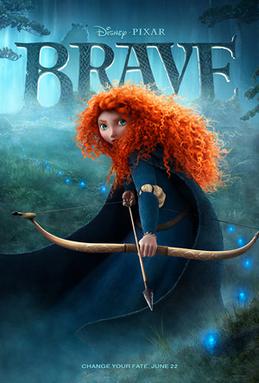
    Review: Brave


    Last weekend we watched the Disney Pixar animation Brave, a film I've been wanting to see for a while. Here are my thoughts on it:

    Highlights:
    • The Plot: It was an interesting story, enough in there to remain exciting, but not too much. It wasn't overwhelmingly complicated and it really complimented the characterisation. Also, overall the plot was about a mother/daughter relationship which is fantastic.
    • The Characters: I loved the characters. They were interesting, they grew and changed, but still maintained a sense of clear personality. I liked that a lot of the minor characters had distinctive aspects to them. The characters love each other, and have to learn to work hard at understanding each other.
    • The Animation:  I don't know a lot about animation but it was really beautiful. It was visually lovely to watch.  I especially liked Merida's hair (not blonde!) and the scenery. I think it was really well put together, and I loved the music.
    • I love the fact they all had Scottish accents, not being Scottish I can't say whether they were real or not but considering until recently all Disney animations were in American voices regardless of the setting (think Aladdin or Mulan) it was refreshing.

    A Few Problems:
    I don't think that these were significant enough to not watch the film, overall it's pretty positive in its gender representations but it is important to be aware of the areas it was lacking:
    • Women: Merida is the heroine and loves nothing more that riding through the forest, shooting arrows. She hates being a princess, the constraints and expectations, especially the idea she will have to get married. Contrasted to Merida is the Queen, who is portrayed as uptight and proper, who has to learn to let go. She's bossy, and frequently nagging her husband. It's a pretty binary representation of what women can be like. (There is a bit of flexibility towards the end)
    • Men: The majority of the male characters are the members of the Scottish clans, all of whom are rough and ready, love fighting and need a strong (uptight, bossy) woman to get them in line. The main male character is Merida's father, who, while he is portrayed as a man who loves his wife and children, is also reasonable incompetent outside of a battle, or hunt. 
    The reason these are problematic representations is that there is a lack of complexity, in order to show a strong woman (what does that even mean anyway?), the male characters must be belittled. In order to show Merida as a strong-willed independent girl, the mother must be the opposite. 

    Overall:
    I really enjoyed Brave, it was a beautiful, exciting, and quite often very sweet, film. I got totally caught up in the plot, even jumped a few times.
    I think it is a fantastic film, certainly good for parents and children (probably a bit scary for younger children). I think it is the sort of film you can simply enjoy but also could spark some really important and great discussions (respect, love understanding etc).